English (UK)
  Italiano
  Français



Shop

Gufo, Pettirosso, Leclerc de Buffon, 1770
25,00 €Gufo e Pettirosso è un’incisione realizzata da Leclerc de Buffon nel 1770, tratta dall’opera Histoire Naturelle des Oiseaux.
Questa acquaforte acquarellata d’epoca presenta un design affascinante e dettagliato, perfetto per gli amanti della natura e della storia dell’arte.
- Sheet size: cm. 20×13 approx.
- Engraving size: cm. 13×9 approx.
- Support: Paper
- Condition: Excellent condition

Gugliemo III d’Orange, 1850
20,00 €Gugliemo III d’Orange è un’incisione realizzata da W. Holl nel 1850, utilizzando la tecnica del burin.
Questa opera rappresenta un finissimo mezzobusto del principe olandese, ispirato a un dipinto di Netscher e pubblicato da S. Orr & C. a Londra.
- Sheet size: cm. 10×13 approx.
- Support: Paper
- Condition: Excellent
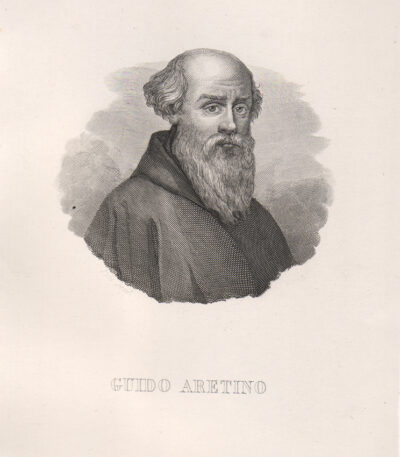
Guido Aretino, 1857
30,00 €Guido Aretino It is an original etching made in 1857, taken from the work Italian Iconoteca – Collection of sixty portraits of illustrious Italians, published in Florence.
This portrait represents Guido Monaco, also known as Guido d'Arezzo or Guido Pomposiano, an important Italian monk and music theorist.
- Sheet size: cm. 23×32
- Size of the joke: mm. 140×180
- Support: Strong paper
- Condition: Good, with some light foxing on the edges, which does not affect the engraving
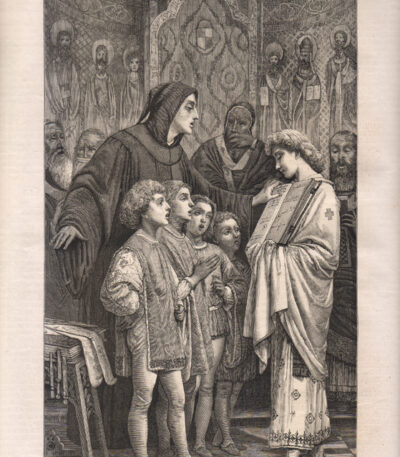
Guido d’Arezzo, 1879
20,00 €Guido d’Arezzo è un’incisione del 1879 che rappresenta il frate Guido d’Arezzo davanti a Papa Giovanni XIX.
Questa xilografia su legno di testa è stata tratta dall’illustrazione Italiana, pubblicata dai Fratelli Treves di Milano nel 1887.
- Sheet size: cm. 17×31 circa
- Engraving size: with margins
- Support: Paper
- Condition: Good, with writing on the back
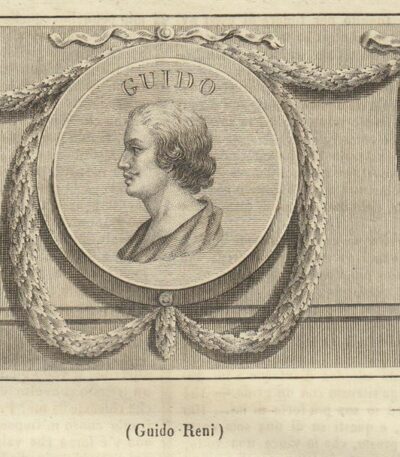
Guido Reni, 1842
15,00 €Guido Reni, 1842 It is a copper engraving taken from thePicturesque Omnibus, published in Naples in 1842.
Questa opera misura circa cm. 13×7 ed è stata estratta da un libro, presentando testo sia intorno che al verso.
- Sheet size: Small
- Condition: Excellent
- Support: Paper
Guido Reni (Bologna, 4 novembre 1575 – Bologna, 18 agosto 1642) è considerato uno dei maggiori pittori e incisori italiani del Seicento.
The entire page of the book containing the print is shipped.
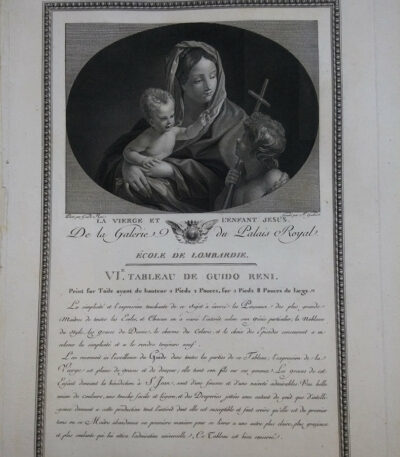
Guido Reni, The Virgin and Child Jesus, 1786
70,00 €The Virgin and the Child Jesus it is an engraving made by Guido Reni in 1786.
This work is an etching on laid paper without watermark, from the Gallery of the Palais Royal, and represents one of the most significant works of the period.
- Sheet size: cm. 24×37 approx.
- Support: Laid paper
- Condition: Excellent condition, nice proof with good contrast
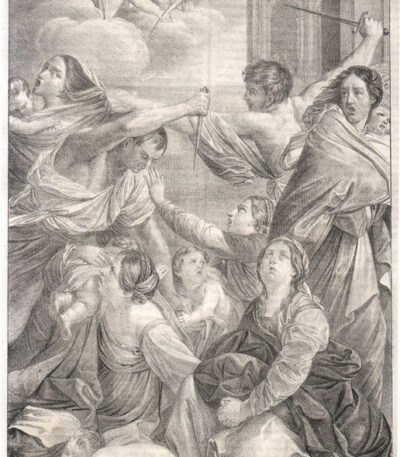
Guido Reni, Strage degli innocenti, 1843
20,00 €Massacre of the Innocents It is a lithograph made by Guido Reni nel 1843, tratta dal volume Picturesque Polyorama, published in Naples.
Questa opera rappresenta una scena drammatica e intensa, con margini quasi assenti e scritte al retro, che ne attestano la provenienza.
- Sheet size: cm. 15×23 approx.
- Engraving size: cm. 15×23 approx.
- Support: Paper
- Condition: Good state of preservation
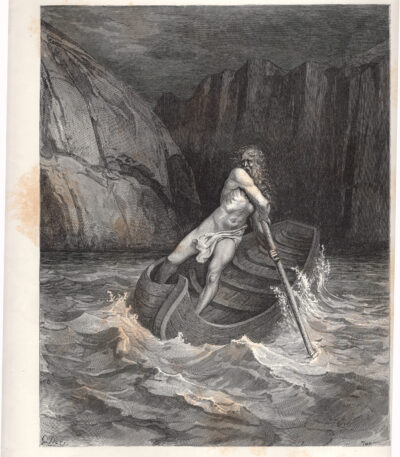
Gustave Dorè – Caronte il traghettatore dell’Inferno
40,00 €-
- Il contesto: Dante e la sua guida, Virgilio, dopo aver superato la porta dell’Inferno (quella con la celebre scritta “Lasciate ogne speranza, voi ch’intrate”), giungono alle rive di un grande fiume scuro: l’Acheronte.
- L’apparizione di Caronte: Verso di loro avanza una barca guidata da un vecchio con i capelli bianchi per la vecchiaia. Il testo riporta in inglese i celebri versi di Dante (Inferno, Canto III, versi 76-84), in cui il traghettatore urla la sua condanna alle anime malvagie, intimando poi a Dante (l’anima viva) di andarsene.
- La descrizione fisica: Caronte viene successivamente descritto come il barcaiolo della “livida palude”, con ruote di fiamme intorno agli occhi. Con il suo remo percuote le anime condannate che esitano a salire a bordo.
- La critica dell’opera d’arte: Il testo conclude elogiando la tavola illustrata, definendola una degna introduzione alla serie di disegni dell’Inferno. Viene sottolineata la potenza della figura, l’oscurità del cielo, le rocce nere e il fiume turbolento le cui onde spumeggiano rabbiosamente contro la barca.
“E ed ecco verso noi venir per nave
un vecchio, bianco per antico pelo,
gridando: «Guai a voi, anime prave!Non isperate mai veder lo cielo:
i’ vegno per menarvi a l’altra riva
nelle tenebre etterne, in caldo e ‘n gelo.E tu che se’ costì, anima viva,
pàrtiti da cotesti che son morti».”
Xilografia su carta di medio spessore, misura dell’immagine cm. 25×20 più margini. Retro bianco.
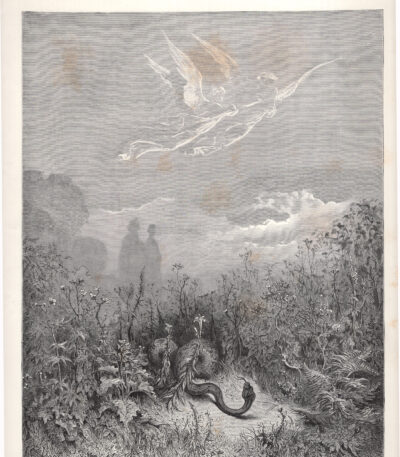
Gustave Dorè – Dante e Virgilio nella Valle Felice
40,00 €- La Valletta dei Principi (Canto VII): L’introduzione descrive l’ingresso di Dante e Virgilio in una splendida valletta. Viene citata la celebre terzina in cui Dante paragona la brillantezza dell’erba e dei fiori a oro, argento, porpora e smeraldi appena nati (“Oro e argento fine, cocco e biacca…”).
- L’arrivo dei due Angeli (Canto VIII, versi 26–32): Viene riportata la traduzione in versi dell’apparizione delle due creature celesti vestite di verde, dotate di spade infocate ma spuntate, poste a guardia della valletta.
- L’apparizione del Serpente (Canto VIII, versi 99–107): Viene descritto l’arrivo della tentazione (il serpente che striscia tra l’erba) e la successiva fuga del rettile, spaventato dal volo dei due angeli paragonati a “astori celesti”.
Xilografia su carta di medio spessore, misura dell’immagine cm. 25×20 più margini. Retro bianco.
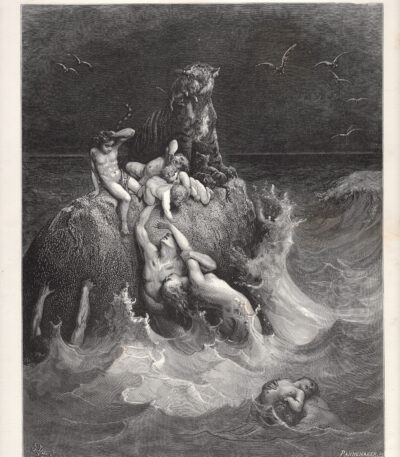
Gustave Dorè – Il Diluvio Universale
40,00 €- I protagonisti sulla roccia: Viene messa in evidenza una tigre con i suoi cuccioli che, insieme ad alcuni bambini, ha trovato rifugio temporaneo su un piccolo frammento di roccia, descritto come l’ultimo lembo di terra solida rimasto in mezzo a un’immensa distesa d’acqua.
- Le figure disperate: Intorno alla roccia, altre figure umane cercano disperatamente di raggiungere lo stesso punto di salvezza, sebbene sia evidente che anche quell’ultimo rifugio verrà presto sommerso.
- Il contrasto drammatico: Il critico fa notare una forte contrapposizione emotiva e visiva nella composizione:
- In primo piano, c’è il tumulto violento dell’acqua e la lotta frenetica per la vita che oppone le famiglie umane e la tigre al loro tragico destino.
- In lontananza, si stende una calma mortale e desolata, che indica la fine del conflitto e il compimento della “vendetta” divina.
Xilografia su carta di medio spessore, autore Gustave Dorè, misura dell’immagine cm. 25×20 più margini. Retro bianco. Stampa del XIX secolo.
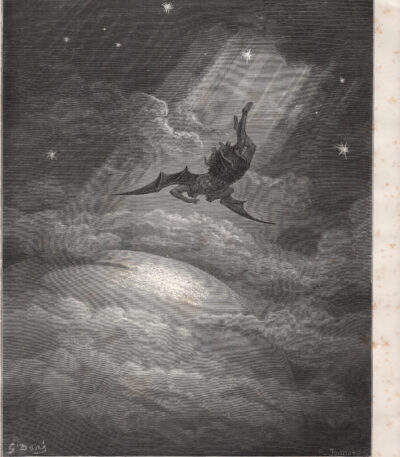
Gustave Dorè – SATANA SI AVVICINA AI CONFINI DELLA TERRA, XIX secolo
40,00 €SATANA SI AVVICINA AI CONFINI DELLA TERRA.
Il soggetto di questa illustrazione singolarmente pregevole è tratto dal “Paradiso perduto” di Milton. Dopo il colloquio tra il Padre e il Figlio, all’inizio del Libro III, occasionato dalla vista di Satana che vola verso questo mondo, allora appena creato, il poeta descrive con grande minuziosità i vagabondaggi del Demonio. Egli si posa prima sulla convessità nuda dell’orbe più esterno della Terra, e vaga per qualche tempo in una regione selvaggia, buia e tempestosa, non ancora sottratta al Caos e del tutto disabitata — una regione conosciuta in epoche successive, come ci dice Milton, come il Limbo della Vanità, o il Paradiso degli Sciocchi, al quale sono destinate “tutte le opere incompiute della mano della Natura” — aborti, embrioni, idioti e le anime di coloro che, in punto di morte, hanno cercato di entrare in Paradiso indossando l’abito di un frate, o affidandosi a reliquie, rosari e dispense papali. Alla fine Satana vede una vasta e radiosa scalinata che sale fino alla porta d’oro e di gioielli del Cielo; e, stando sul gradino più basso di questa, contempla un’ampia via di passaggio che scende verso la “beata dimora del Paradiso”. Tuttavia, essendo ancora ignaro della dimora dell’uomo, si lancia nel firmamento stellato e infine atterra sul corpo luminoso del Sole, dove incontra Uriel e, trasformatosi nelle sembianze di un giovane angelo, gli domanda in quale degli orbi visibili dal globo solare si trovi la dimora dell’uomo. Uriel risponde: —”Guarda in basso verso quel globo, il cui lato rivolto di qua brilla di luce riflessa, sebbene proveniente da qui. Quel luogo è la Terra, la dimora dell’uomo; quella luce è il suo giorno, che altrimenti, come l’altro emisfero, sarebbe invaso dalla notte; ma la vicina Luna(chiamala così quella stella di fronte a lei) il suo aiuto tempestivo interpone, e, nel suo percorso mensile sempre rinnovato, avanzando a metà del cielo, con la luce presa in prestito il suo volto triforme riempie e svuota per illuminare la Terra, e nel suo pallido dominio scaccia la notte. Quel punto verso cui indico è il Paradiso, la dimora di Adamo; quelle alte ombre, la sua dimora: la tua strada non puoi mancare; la mia richiede le mie cure.”
Xilografia su carta di medio spessore, misura dell’immagine cm. 25×20 più margini. Retro bianco.
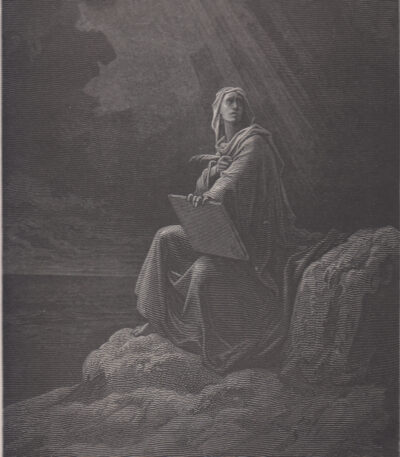
Gustave Dorè (1832-1883), John on Patmos
30,00 €John in Patmos It is a woodcut engraving made by Gustave Dore (1832-1883), a famous French illustrator.
This work, which measures approximately cm. 20×24, is printed on a sheet of cm. 29×37 approximately, made in thick paper and has a blank back.
The signature is located at the bottom left G.ve Dorè, while in the centre the theme of the engraving is reported in Dutch.
The table is taken from the volume Bijbel, dat is de Gansche Heilige Schrift … Ouden en Nieuwen Testaments, met honderd platen van Gustave Doré, published in 1873.
- Sheet size: cm. 29×37 approx.
- Engraving size: cm. 20×24 approx.
- Support: Thick paper
- Condition: Perfect condition

Gustave Dorè (1832-1883), The Angel and the Women
30,00 €The Angel and the Women It is a woodcut engraving made by Gustave Dore (1832-1883), a master of illustration and graphics.
This work, which measures approximately 20x24 cm, is printed on a sheet of 29x37 cm, made in thick paper and has a blank back.
The signature is present at the bottom left G.ve Dorè, while in the center is the theme of the Dutch engraving.
The table is taken from the volume Bijbel, dat is de Gansche Heilige Schrift … Ouden en Nieuwen Testaments, met honderd platen van Gustave Doré, published in 1873.
- Sheet size: cm. 29×37 approx.
- Engraving size: cm. 20×24 approx.
- Support: Thick paper
- Condition: Excellent condition

Gustave Dorè (1832-1883), Death of Stephen
30,00 €Death of Stephen It is a woodcut engraving made by Gustave Dore (1832-1883), a master of illustration.
This work, which measures approximately 20x24 cm on a 29x37 cm sheet, is printed on thick paper with the back blank. The signature is on the bottom left G.ve Dorè, while in the center is the theme of the Dutch engraving.
The table is taken from the volume Bijbel, dat is de Gansche Heilige Schrift … Ouden en Nieuwen Testaments, met honderd platen van Gustave Doré, published in 1873.
- Sheet size: cm. 29×37 approx.
- Engraving size: cm. 20×24 approx.
- Support: Thick paper
- Condition: Perfect condition

Gustave Dorè (1832-1883), Paul in Ephesus
30,00 €Paul in Ephesus It is a woodcut engraving made by Gustave Dore (1832-1883), which represents a significant biblical theme.
This work is part of the publication Bijbel, dat is de Gansche Heilige Schrift … Ouden en Nieuwen Testaments, met honderd platen van Gustave Doré, published in 1873.
- Sheet size: cm. 29×37 approx.
- Engraving size: cm. 20×24 approx.
- Support: Thick paper, white on the back
- Condition: Perfect condition

Gustave Doré, Bible, 1869
30,00 €Resurrection of Jairus' daughter It is a woodcut engraving made by Gustave Doré in 1873.
This work is part of the illustrated Bible, Bijbel, dat is de Gansche Heilige Schrift … Ouden en Nieuwen Testaments, which includes one hundred Doré plates.
- Sheet size: cm. 29×37 approx.
- Engraving size: cm. 20×24 approx.
- Support: Thick paper, white on the back
- Condition: Perfect condition

Gustave Doré, Bible, 1869
30,00 €Gustave Doré, Bible It is a woodcut engraving made in 1873, which represents Jesus calms the storm on a boat.
This work is taken from the volume Bijbel, dat is de Gansche Heilige Schrift … Ouden en Nieuwen Testaments, illustrated with one hundred plates by Gustave Doré.
- Sheet size: cm. 29×37 approx.
- Engraving size: cm. 20×24 approx.
- Support: Thick paper, white on the back
- Condition: Perfect condition

Gustave Doré, Bible, 1869
30,00 €Jesus: The Sermon on the Mount It is a woodcut engraving made by Gustave Doré in 1873.
This work is part of the illustrated Bible, entitled Bijbel, dat is de Gansche Heilige Schrift … Ouden en Nieuwen Testaments, which includes one hundred plates by the artist.
- Sheet size: cm. 29×37 approx.
- Engraving size: cm. 20×24 approx.
- Support: Thick paper, white on the back
- Condition: Perfect condition

Gustave Doré, Bible, 1869
30,00 €Jesus preaches on the Sea of Galilee It is a woodcut engraving made by Gustave Dore In the 1873.
This work is taken from the Bible, one of his most famous works, which includes illustrations for the Old and New Testaments.
- Sheet size: cm. 29×37 approx.
- Engraving size: cm. 20×24 approx.
- Support: Thick paper, white on the back
- Condition: Perfect condition

Gustave Doré, Bible, 1869
30,00 €Jesus: The Temptation in the Desert It is a woodcut engraving made by Gustave Dore in 1873.
This work is part of the Illustrated Bible, a monumental work that collects Doré's illustrations for the Old and New Testaments.
- Sheet size: cm. 29×37 approx.
- Engraving size: cm. 20×24 approx.
- Support: Thick paper, white on the back
- Condition: Perfect condition

Gustave Doré, Bible, 1869
30,00 €Gustave Doré, Bible It is a woodcut engraving made in 1873, which represents Jesus among the doctors in the Temple.
This work is part of the famous illustrated Bible, Bijbel, dat is de Gansche Heilige Schrift … Ouden en Nieuwen Testaments, which includes one hundred plates by Gustave Doré.
- Sheet size: cm. 29×37 approx.
- Engraving size: cm. 20×24 approx.
- Support: Thick paper, white on the back
- Condition: Perfect condition

Gustave Doré, Bible, 1869
30,00 €The Massacre of the Innocents It is a woodcut engraving made by Gustave Doré in 1873.
This work is part of the illustrated Bible, Bijbel, dat is de Gansche Heilige Schrift … Ouden en Nieuwen Testaments, which includes one hundred Doré plates.
- Sheet size: cm. 29×37 approx.
- Engraving size: cm. 20×24 approx.
- Support: Thick paper, white on the back
- Condition: Perfect condition

Gustave Doré, Bible, 1869
30,00 €The Flight into Egypt It is a woodcut engraving made by Gustave Dore in 1873.
This work is part of the illustrated Bible, Bijbel, dat is de Gansche Heilige Schrift … Ouden en Nieuwen Testaments, which includes one hundred Doré plates.
- Sheet size: cm. 29×37 approx.
- Engraving size: cm. 20×24 approx.
- Support: Thick paper, white on the back
- Condition: Perfect condition
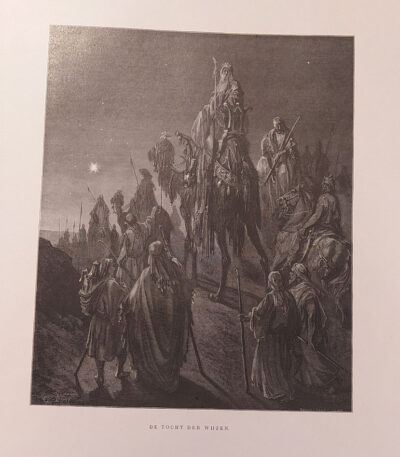
Gustave Doré, Bible, 1869
30,00 €The Three Wise Men on their journey It is a woodcut engraving made by Gustave Dore in 1873.
This work is part of the illustrated Bible, Bijbel, dat is de Gansche Heilige Schrift … Ouden en Nieuwen Testaments, which includes one hundred Doré plates.
- Sheet size: cm. 29×37 approx.
- Engraving size: cm. 20×24 approx.
- Support: Thick paper, white on the back
- Condition: Perfect condition